Winning a federally funded project is only the beginning.
For contractors working on projects supported by federal grants or other federal financial assistance, the contract often carries requirements that go well beyond the technical scope of work. Prevailing wages, domestic sourcing, certified payroll, debarment certifications, environmental requirements, lobbying restrictions, contract flow-downs, and recordkeeping can all become part of the contractor’s responsibilities.
Many of these requirements originate in 2 CFR Part 200, commonly referred to as the Uniform Guidance.
For contractors, one of the most important sections is Appendix II to 2 CFR Part 200, which identifies provisions that must be included in contracts under federal awards when applicable. Section 200.327 specifically requires recipients and subrecipients to include the applicable Appendix II provisions in their contracts.
The practical takeaway is simple:
If your company is awarded a federally funded construction project, make sure you understand your obligations have a strategy for Uniform Guidance compliance.
Start With the Contract, Not Just 2 CFR 200
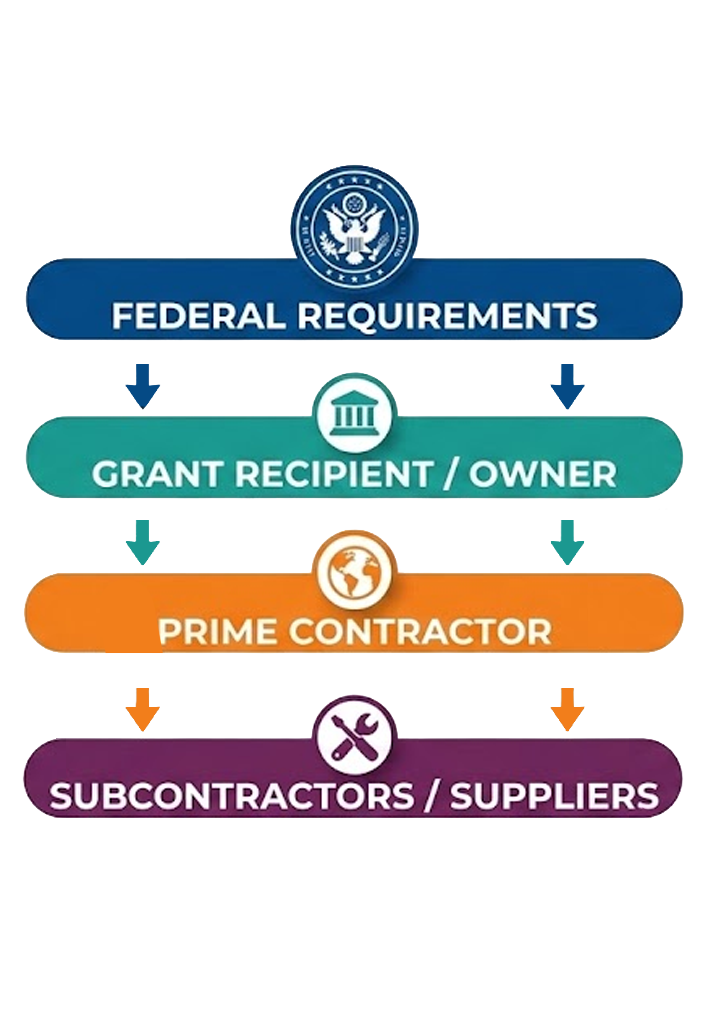
A contractor generally is not the direct recipient of the federal grant. A city, county, school district, nonprofit, utility, university, or other organization may have received the federal award and then procured the contractor.
That distinction matters.
The recipient is responsible for administering the federal award, but many requirements are incorporated into the construction contract and flow down to the contractor and, in many cases, its subcontractors.
Appendix II establishes a baseline of federal contract provisions, but it is not necessarily the complete list.
Contractors should review:
- the executed construction contract;
- federal grant terms and conditions incorporated into the contract;
- Appendix II provisions;
- applicable agency-specific requirements;
- the applicable Davis-Bacon wage determination;
- Build America, Buy America requirements;
- supplemental certifications and forms; and
- requirements that must be included in subcontracts and purchase orders.

A federal project may have requirements originating from several different statutes and regulations at the same time.
Two of the most important elements construction contractors are Davis-Bacon Act and the Build America, Buy America Act, commonly referred to as BABA or BABAA.
Davis-Bacon and Related Acts: More Than Paying a Prevailing Wage
The Davis-Bacon and Related Acts (DBRA) include more than pieces of legislation written and modified in the 95 years since the Davis-Bacon Act was enacted in 1931. They general exist today under three interrelated pieces of legislation: The Davis-Bacon Act, the Copeland Anti-Kickback Act, and the Contract Work Hours Safety Standard Act.
Davis-Bacon Act
 Appendix II specifically addresses the Davis-Bacon Act. It requires Davis-Bacon provisions in construction contracts exceeding $2,000 when Davis-Bacon is required by the applicable federal program legislation.
While it applies, the Davis-Bacon Act requires contractors and subcontractors must generally pay covered laborers and mechanics no less than the prevailing wage and fringe benefit rates contained in the applicable U.S. Department of Labor wage determination.
For a contractor, however, Davis-Bacon compliance goes much further than checking wage rates.
A compliant program typically requires tracking:
- worker names and identifying information;
- labor classifications tied to the DOL Wage Determination;
- daily and weekly hours on Certified Payroll Form WH-347;
- basic hourly wage rates;
- fringe benefit obligations;
- cash paid in lieu of fringe benefits;
- deductions;
- apprenticeship status;
- subcontractor payroll;
- additional classifications or conformances; and
- corrections or restitution when underpayments are identified.
Covered workers must be paid weekly, and applicable Davis-Bacon contract provisions must be incorporated into the project documents.
Weekly certified payroll reporting is also a central part of traditional Davis-Bacon compliance. Contractors commonly use Form WH-347, together with the required Statement of Compliance. DOL specifically identifies the WH-347 process as a means of documenting wages, hours, classifications and deductions for workers performing on covered projects.
The prime contractor should also recognize that its compliance exposure does not necessarily stop with its own employees. Subcontractors performing covered construction can have the same prevailing wage obligations, making subcontractor onboarding and payroll review an important part of the prime contractor’s compliance process.
Copeland Anti-Kickback Act
Where Davis-Bacon provisions apply, Appendix II also requires compliance with the Copeland “Anti-Kickback” Act.
The basic concept is straightforward: contractors and subcontractors cannot induce workers to give up any portion of compensation to which they are entitled.
In practice, this makes accurate documentation of deductions particularly important.
Payroll deductions should be legitimate, properly authorized where required, and clearly documented. Unexplained deductions on certified payroll can quickly become a compliance issue.
Contract Work Hours and Safety Standards Act
Another Appendix II requirement that commonly accompanies federally funded construction is the Contract Work Hours and Safety Standards Act, or CWHSSA.
Where applicable, contracts exceeding $100,000 involving mechanics or laborers must include CWHSSA requirements. Covered workers generally must receive at least one-and-one-half times their basic rate of pay for hours worked over 40 in a workweek.
This is separate from the Davis-Bacon prevailing wage calculation itself.
For contractors, this means overtime should not simply be evaluated by multiplying the entire prevailing wage package by 1.5. The interaction among the worker’s basic rate, fringe benefits, Davis-Bacon requirements, CWHSSA, the Fair Labor Standards Act, and potentially state overtime law should be evaluated correctly.
This is one area where relatively small payroll errors can become significant when repeated across a large workforce or multiple months of construction.
Build America, Buy America Act
 For many infrastructure and clean energy contractors, **Build America, Buy America Act (BABA or BABAA) compliance can be as important as labor compliance**.
BABA, passed as part of the Bipartisan Infrastructure Act in 2021, applies a domestic sourcing preference to federally assisted infrastructure projects. Under 2 CFR Part 184, applicable federal awards must require certain iron and steel products, manufactured products, and construction materials incorporated into the project to be produced in the United States.
The requirement must be incorporated into applicable subawards, contracts and purchase orders.
For contractors, this means BABA compliance cannot be handled effectively by asking vendors at the end of construction whether their products were “made in America.”
Compliance should begin during procurement.
Products first need to be properly categorized.
Under the current rules:
Iron and steel products generally must have all manufacturing processes, from initial melting through coatings, performed in the United States.
Manufactured products must generally be manufactured in the United States and meet the applicable domestic component-cost requirement, currently greater than 55% unless another applicable standard applies.
This category is especially important for solar energy projects, because many of the most critical system components fall under the manufactured products classification rather than construction materials.
In a typical solar installation, manufactured products may include:
- photovoltaic (PV) modules (solar panels);
- inverters (string, central, or microinverters);
- battery energy storage systems (BESS) and associated battery management systems;
- combiner boxes and rapid shutdown devices;
- monitoring and control systems;
- switchgear and power conditioning equipment; and
- pre-assembled electrical skids or packaged power units.
For these items, compliance is not just about where final assembly occurs. Contractors must evaluate whether the product is considered “manufactured in the United States” under BABA and whether it meets the required domestic content threshold.
This becomes particularly complex with solar modules, because they are typically composed of multiple subcomponents sourced globally, including:
Even when a module is assembled in the United States, the domestic content calculation may still depend on the origin of these subcomponents and whether the final manufacturing process meets the applicable federal definition. The rules are complex and even some US Solar manufacturers, like Mission Solar, have published information to add to the ambiguity of compliance.
Inverters and power electronics present similar challenges. While final assembly or firmware configuration may occur domestically, key components such as semiconductors, circuit boards, capacitors, and transformers are often globally sourced. Determining whether the product qualifies as a domestic manufactured product requires careful review of both the manufacturing location and the cost of components.
For battery energy storage systems, the analysis can be even more nuanced. Battery cells, modules, racks, thermal management systems, and control software may originate in different countries, and the final system may be assembled in the United States without automatically satisfying domestic content requirements.
Because of this complexity, manufactured products in solar projects often require a component-level review, not just a supplier certification.
Construction materials generally must have the required manufacturing processes performed in the United States. Covered categories include items such as non-ferrous metals, plastic and polymer-based products, glass, fiber optic cable, lumber, engineered wood and drywall.
For a clean energy contractor, equipment categorization can quickly become complex.
Solar modules, inverters, switchgear, transformers, structural steel, conduit, wire, racking, battery systems, control equipment and other project materials may not all fall into the same BABA category.
That classification matters because different domestic-content tests apply to different product categories.
BABA Documentation Should Start Before Purchase Orders Are Issued
A contractor should develop a BABA compliance matrix early in the project.
At a minimum, the file should identify:
- each significant product incorporated into the project;
- manufacturer;
- country of manufacture;
- applicable BABA category;
- required domestic standard;
- supplier or manufacturer certification;
- purchase order;
- supporting product documentation; and
- any applicable waiver.
The objective is to create a clear chain of documentation demonstrating that permanent materials incorporated into the project satisfy the applicable domestic sourcing requirement.
If a compliant product cannot be obtained, BABA provides a federal waiver process under certain circumstances, including public-interest, nonavailability, and unreasonable-cost situations. The contractor should coordinate any potential waiver with the grant recipient and federal agency before installing a noncompliant product, rather than assuming that a waiver can be obtained retroactively.
Other Appendix II Requirements Contractors Should Recognize
Davis-Bacon and BABA typically receive the most attention on construction projects, but Appendix II contains several additional requirements.
Depending on the project and contract value, these can include:
Contract remedies. Contracts above the Simplified Acquisition Threshold must address remedies, sanctions, or penalties for contractor breach.
Termination provisions. Contracts above $10,000 must address termination for cause and convenience.
Clean Air Act and Federal Water Pollution Control Act. Contracts and subgrants exceeding $150,000 must include applicable compliance provisions.
Debarment and suspension. Awards cannot be made to parties that are excluded from federal contracting or assistance programs through SAM.gov. Contractors should also pay attention to subcontractor eligibility where flow-down requirements apply.
Byrd Anti-Lobbying Amendment. Contractors bidding for certain awards exceeding $100,000 must provide required lobbying certifications, with disclosure requirements flowing through contracting tiers.
Recovered materials. Certain governmental recipients and their contractors must comply with federal recovered-material procurement requirements for designated EPA products.
There may also be requirements involving equal employment opportunity, telecommunications restrictions, bonding, environmental conditions, agency-specific certifications, reporting and records access.
The key point is that Appendix II should be treated as a critical compliance checklist, not simply contract language.
Flow-Down Requirements Matter
Prime contractors should pay particular attention to subcontract agreements.
Many federal requirements do not stop at the prime level.
If a subcontractor employs electricians, equipment operators, laborers or other covered workers on a Davis-Bacon project, that subcontractor’s payroll can become part of the prime contractor’s compliance exposure.
Similarly, BABA requirements may need to flow into equipment purchase orders so manufacturers and suppliers understand that domestic sourcing documentation is required before products are approved.
A strong subcontracting process should therefore identify applicable federal provisions before the subcontract is signed.
Build the Compliance File During Construction
Federal recipients are required to oversee contractors to ensure performance in accordance with contract terms, and federal agencies or pass-through entities may review records associated with the federal award. Noncompliance can lead to withheld payments, disallowed costs, suspension or termination of federal funding, and other remedies.
For the contractor, that can translate into delayed payment, withheld retainage, corrective work, payroll restitution, replacement of noncompliant materials, or disputes over reimbursable costs.
The better approach is to maintain a live compliance file throughout construction.
How Clean Energy Help Can Support Contractors
Clean Energy Help works with contractors navigating the compliance requirements attached to federally funded clean energy and infrastructure projects.
CEH can support contractors with:
- federal contract and Appendix II compliance reviews;
- Davis-Bacon wage determination and classification analysis;
- certified payroll review and tracking;
- fringe benefit and overtime compliance;
- subcontractor onboarding and compliance monitoring;
- supplemental wage classification requests;
- BABA product categorization;
- domestic-content documentation and supplier certification review;
- BABA compliance matrices;
- waiver support and documentation;
- debarment and required federal certifications;
- federal contract flow-down requirements; and
- project compliance files prepared for owner, agency and audit review.
A federally funded project can be a tremendous opportunity for a contractor. It can also bring requirements that are significantly different from a traditional commercial project.
The key is to understand those requirements when the contract is awarded, establish the compliance system before construction begins, and document compliance as the work occurs.
Clean Energy Help helps contractors do exactly that—turning a complicated set of federal requirements into a manageable project compliance process.