
Clean energy and resilience work continues to accelerate across Florida as communities, businesses, and public agencies collaborate on practical solutions for long-term sustainability. Over the past month, Clean Energy Help has participated in regional resiliency planning, commercial solar education, and technical discussions around next-generation building systems.
This issue highlights ongoing community engagement with the Tampa Bay Regional Planning Council, key takeaways from Greentech Renewables’ Commercial Sales Workshop, insights from the City of St. Petersburg’s Lunch and Learn series, and several upcoming opportunities to connect with clean energy and sustainability leaders across the state.
What Did You Do This Earth Month?

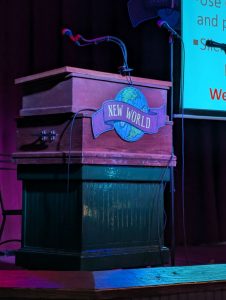
In the lead up to Earth Week, Clean Energy Help’s President Caleb Quaid spoke at the Pints of Science event hosted by Nancy Bird, proprietress of New World Tampa. The setting was informal, but the conversation carried real weight, as Caleb shared insights from his work with Regenerative Shift, bioregional planning, and his involvement with the Tampa Bay Regional Planning Council. Topics ranged from soil health to watershed management, grounded in how these systems show up locally in the Tampa Bay region. The evening felt less like a presentation and more like a community dialogue, bookended by community connector Nick Ewing and USF Professor Thomas Culhane, who wove music into the conversation and kept the energy high throughout the night.
Our Project Coordinator, Miguel Maysonet III, spent Earth Week in Milwaukee at the Champions Retreat hosted by B Lab U.S. & Canada. The gathering brought together leaders from across the B Corp ecosystem, creating space for both big-picture conversations and meaningful relationship building.
Miguel connected with his communities from B Academics, where he serves as Vice Chair for B Local Engagement, and Florida for Good, while attending sessions on leadership, policy, and even the gamification of reducing greenhouse gas emissions at the municipal level. A standout moment was connecting with renewable energy companies that are Certified B Corporation organizations, seeing firsthand how others in the clean energy space are holding themselves to rigorous social and environmental standards. The week struck a strong balance between strategy and community, reinforcing the role that values driven businesses can play in shaping local impact.
Get Involved
Clean Energy Help President, Caleb Quaid, is the co-chair of the Resilient Land Use Committee with the Tampa Bay Regional Planning Council (TBRPC). The group focuses on key goals around land use in the TBRPC’s Regional Resiliency Action Plan to build resiliency in the built environment, natural environment, and in regional food systems. His focus is on building stakeholder engagement and coordinating funding for regenerative projects at the regional level, as our regional resiliency is dependent on the systems of nature and how we work with them.
The working group is open to the public, so if you have interest and expertise to bring to the discussion, we encourage you to sign up here.
Did You Miss Last Month's Post?
Clean Energy Help Is Here
Clean Energy Help kicked off 2026 with major momentum, helping commercial solar projects secure Safe Harbor protections before new FEOC compliance rules took effect and guiding businesses and municipalities through the evolving clean energy landscape under the One Big Beautiful Bill. The newsletter highlighted key insights on 2026 commercial solar tax credits, featured a Tampa Bay Times editorial by President Caleb Quaid on Florida’s energy future, and showcased a collaborative Energy Investment Roadmap developed with the City of St. Petersburg and IDEAS For Us. It also introduced Miguel Maysonet III as the company’s new Project Coordinator, supporting Clean Energy Help’s continued growth and commitment to impactful clean energy solutions.
Project Spotlight
St. Petersburg
Lunch and Learn
The City of St. Petersburg’s Lunch and Learn brought together a thoughtful mix of local engineers, architects, and members of the wastewater team for a conversation centered on practical building decarbonization technologies. Hosted by the City’s Sustainability and Resilience Department, with thanks to Maeven Rogers, and organized by Clean Energy Help, the session featured presentations from Jay Egg of Egg Geothermal and Matthew Kruse of Blue Frontier. The event created space for both technical discussion and real-world application, with a clear focus on how emerging systems can support more efficient, resilient buildings.
Jay Egg’s presentation focused on geothermal applications in Florida, specifically non-consumption well doublets and aquifer thermal energy transfer (ATET). He explained how Egg Geothermal moved away from earlier fully closed-loop piping systems and toward approaches better suited for conditions “south of the Mason-Dixon line”. The discussion touched on load balancing, aquifer performance over time, and the difference between the type of geothermal work being done in Florida versus the turbine-based power generation many people associate with geothermal in other regions. Local examples helped ground the discussion, including 1950 Central Avenue in St. Petersburg, Seven Seas Lagoon, Avian Pointe in Apopka, and the Pinellas County Public Safety Services Complex.
The session also highlighted the practical considerations that shape geothermal adoption. Jay noted that project economics tend to improve with scale. Additional discussion touched on source and sink projects, subgrade utilities, and the performance difference between air cooling and geothermal, with Jay noting an approximate 20% COP advantage for geothermal systems.
Matthew Kruse then introduced Blue Frontier’s Dedicated Outdoor Air System, or BF-DOAS, a system designed to independently control humidity and temperature while improving energy efficiency and indoor comfort. Blue Frontier positions the technology as a liquid desiccant-enhanced DOAS that conditions 100 percent fresh ventilation air, removes moisture efficiently, and uses embedded energy storage to help eliminate peak demand. The system is marketed as offering up to 3X moisture removal efficiency, up to 6 hours of embedded energy storage, full PLC controls and monitoring, and improved performance during heat waves and high humidity conditions. Altogether, the Lunch and Learn offered a valuable look at two different but complementary approaches to high-performance building systems in Florida’s climate.
Greentech Renewables
Tampa Bay Workshop
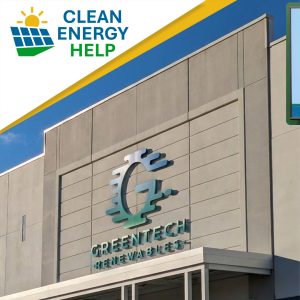
Greentech Renewables recently hosted a Commercial Sales Workshop in Palmetto that offered a strong look into the realities of selling and structuring commercial solar projects. One of the clearest takeaways was that commercial solar is fundamentally different from residential work. The conversation emphasized the value of specialization by project type, whether that means schools, manufacturing facilities, car dealerships, or other niches, as well as the importance of using job walks not only to gather project data, but also to help move clients further into the sales process.
A major theme throughout the workshop was the need for a more nuanced understanding of utility billing. Demand charges, in particular, were discussed as a critical factor in commercial projects, since a customer’s highest usage spike during short billing intervals can heavily affect monthly costs. Speakers stressed that solar alone cannot fully solve for demand charges, especially when load profiles do not align with solar production, and that battery storage often plays an important role in reducing peak demand. The repeated use of the phrase “case-by-case” captured the spirit of the day well, reinforcing that commercial energy strategy requires tailored thinking rather than one-size-fits-all sales language.
The workshop also highlighted the growing importance of technical fluency across sales, consulting, and installation teams. Proposal tools like Aurora and HelioScope were referenced as valuable for improving collaboration, while additional discussion touched on roof types, tariff negotiation, battery interval analysis, and niche market opportunities. Clean Energy Help’s President Caleb Quaid also presented on topics including OBBBA, safe harbor timing, FEOC, Domestic Content, and Elective Payment, prompting thoughtful audience questions around compliance checklists, MACRS depreciation, audit readiness, and project eligibility.
The session closed with useful insight into Greentech’s continued expansion in the commercial market, including added support around HelioScope, financial analysis, pre-sale site visits, premium plan sets, and installation labor. Another practical takeaway came from the FEOC and Domestic Content discussion: compliance review should be as detailed as possible, down to SKU and serial number tracking. Altogether, the workshop served as a strong reminder that success in commercial solar depends on technical accuracy, cross-functional communication, and a willingness to meet each project on its own terms.
Upcoming Events
Clean Energy Help is a proud sponsor of the Southeast Sustainability Directors Network Annual Meeting in Tampa from May 4 to 7. This meeting brings together local government leaders from across the region to share ideas, build relationships, and learn from real world sustainability and resilience initiatives.
Clean Energy Help will be attending the Florida Solar & Storage Summit in Orlando from May 7 to 8. This summit brings together the region’s top clean energy leaders to align on policy, incentives, and the future of commercial solar.