
Turning Clean Energy Tax Credits Into Project Funding
For tax-exempt organizations, clean energy tax credits once offered little practical value. Elective Payment, often called “Direct Pay,” changed that and can convert eligible federal credits into project funding for nonprofits, municipalities.
Created under Section 6417 of the Internal Revenue Code, Elective Payment allows eligible tax-exempt and governmental entities to receive certain clean energy credits as payments from the IRS. A school district installing solar, a nonprofit organization adding battery storage, or a local government developing a geothermal project may receive substantial funding despite having no federal income tax liability.
The process is not simply “build the project and file for a refund.” Organizations must evaluate eligibility before procurement, document funding sources, assess equipment sourcing, satisfy construction requirements, complete IRS pre-filing registration, and file the appropriate forms.
Who Is Eligible for Elective Pay?
Elective Payment is available to eligible tax-exempt and governmental entities that qualify for an underlying federal clean energy credit. Potentially eligible organizations include:
🌱 Nonprofit organizations
⛪ Churches and places of worship
🏫 Schools and school districts
🏛️ State, local, and tribal governments
⚡ Rural electric cooperatives
🏘️ Homeowners Associations
Elective Payment is not a separate incentive. It allows eligible organizations to monetize credits such as:
- Section 48E Clean Electricity Investment Credit
- Section 45Y Clean Electricity Production Credit
- Section 48 Energy Credit
- Section 45U Zero-Emission Nuclear Power Production Credit
- Section 45Q Carbon Oxide Sequestration Credit
- Section 45V Clean Hydrogen Production Credit
- Section 45Z Clean Fuel Production Credit
- Section 48C Qualifying Advanced Energy Project Credit
- Section 45X Advanced Manufacturing Production Credit
Other credits may qualify depending on current law, technology, and timing. Sections 30C and 45W have expired for certain newly placed-in-service or acquired property, so organizations should confirm current statutory authority before relying on them.
For solar, standalone BESS, solar-plus-storage, and certain geothermal projects, Section 48E will often be the primary credit. It generally applies to qualified clean electricity facilities and energy storage technology placed in service after 2024. Certain geothermal property may instead qualify under Section 48, depending on its classification and placed-in-service date.
The organization must first qualify for the underlying credit. That may require establishing eligible basis, determining the credit percentage, satisfying Prevailing Wage and Apprenticeship requirements, evaluating bonus credits, and meeting procurement rules.
The right time to evaluate eligibility is before contracting or purchasing equipment.
Key Placed-in-Service Deadlines
| Credit or project type | Applicable code | Placed-in-service deadline |
|---|---|---|
|
Solar photovoltaic facility |
Section 48E |
December 31, 2027 |
|
Battery energy storage system, including standalone BESS |
Section 48E |
December 31, 2032 |
|
Geothermal heat pump and other eligible geothermal property |
Section 48 |
December 31, 2032 |
|
Qualified clean electricity production facility |
Section 45Y |
December 31, 2027 |
|
Commercial clean vehicle |
Section 45W |
September 30, 2025 |
|
Alternative fuel vehicle refueling property |
Section 30C |
June 30, 2026 |
Practical Implication: Organizations considering Section 48E Solar projects should evaluate schedules immediately. A project that cannot reasonably be placed in service by December 31, 2027 may not be viable for Section 48E Elective Payment.
The placed-in-service deadline is different from the construction-start deadline. A project may begin construction on time but still fail if it is not placed in service by the applicable date. Schedules should account for design, permitting, procurement, interconnection, construction, commissioning, and IRS registration.
Funding – No Excess Benefit Rule
Start with one question: How is the project being paid for?
Tax-exempt organizations often combine appropriations, grants, utility incentives, philanthropic funding, financing, and anticipated Elective Payment.
A grant does not automatically eliminate the credit. IRS regulations generally allow certain tax-exempt grants and forgivable loans to remain in the basis of investment-credit property.
The key limitation is the No Excess Benefit Rule.
An organization should not receive restricted tax-exempt funding specifically intended to pay for eligible property and then receive an Elective Payment that causes the combined benefit to exceed the property’s cost.
For example, if a $1 million project receives an $800,000 restricted grant and generates a $300,000 credit, the combined benefit would be $1.1 million. The credit may therefore need to be reduced by $100,000 to cover up to 100% of the cost of the system through restricted funding and Elective Payment.
Key Insight: How you document your project funding is critical to maximize your incentives.
Review grant agreements, award letters, budgets, funding restrictions, procurement records, and the organization’s contribution before finalizing the financing structure and before filing.
Clean Energy Help can help review funding structures, identify documentation gaps, and coordinate the project budget with the anticipated Elective Payment.
FEOC Material Assistance
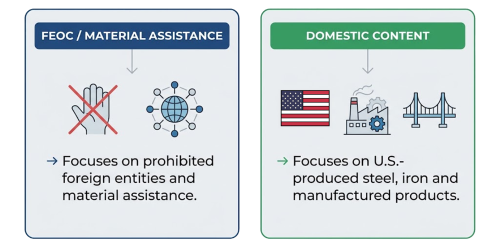
Projects beginning construction after December 31, 2025 face restrictions involving Prohibited Foreign Entities, commonly addressed under the broader Foreign Entity of Concern (FEOC) terminology.
The One Big Beautiful Bill Act of 2025 added FEOC Material Assistance restrictions to Sections 45Y and 48E. Solar, wind, and battery storage projects receiving too much material assistance from a Prohibited Foreign Entity may become ineligible for the credit altogether.
Key Insight: FEOC Material Assistance Certification is required for your project to receive the Section 48E credit.
IRS Notice 2026-15 provides interim rules for calculating a project’s Material Assistance Cost Ratio, or MACR. The calculation evaluates project components and the percentage attributable to sources that are not prohibited foreign entity sources. Thresholds vary by technology, year, and statutory provision. For solar projects beginning construction in 2026, the threshold is 40 percent.
Battery storage and manufactured components may be subject to different calculations. For solar-plus-storage projects, compliant batteries can be especially difficult to source. A battery sold by a domestic distributor may still contain components or materials creating FEOC or Material Assistance concerns.
Geothermal projects may also require review of pumps, heat exchangers, controls, drilling equipment, power electronics, and other major components.
Organizations should require supplier certifications, component-level sourcing information, contractual representations, audit rights, and notice of substitutions from EPC contractors, BESS suppliers, geothermal contractors, and manufacturers.
Key Insight: FEOC compliance must be addressed during procurement.
Domestic Content Bonus Credit
Along with mandatory FEOC Material Assistance compliance, organizations should consider the optional Domestic Content Bonus Credit, which adds 10% to the Section 48E credit (from 30% to 40%). With tariffs and FEOC concerns, it is often easiest to work with domestic providers to get the documentation needed and earn the extra 10% bonus credit.
For large solar projects, Domestic Content is a requirement for Elective Pay. If your project is over 1 mW AC, domestic content requirements become mandatory (along with Prevailing Wage and Apprenticeship Requirements).
Key Insight: Resolve FEOC and Domestic Content issues during planning, not while preparing the tax return.
Process
Once the project is structured and documented, the process generally involves five (5) steps:
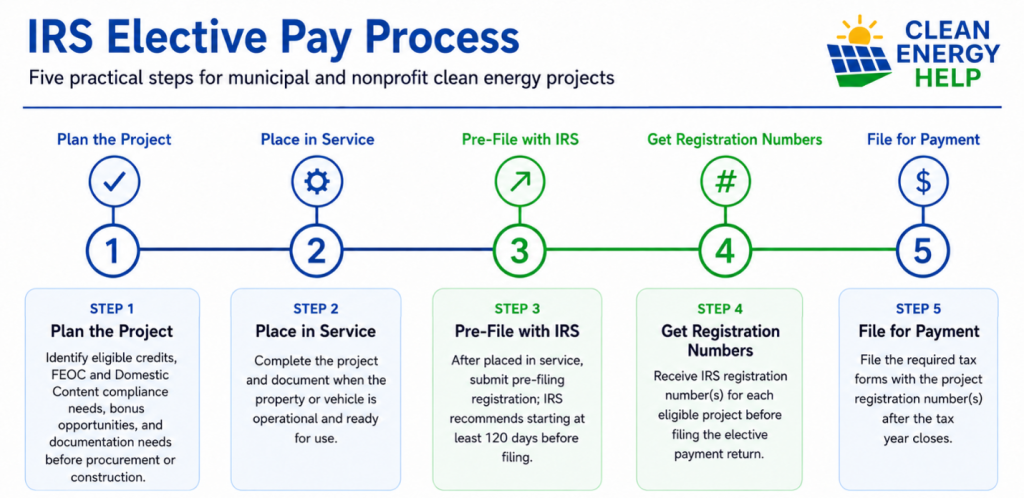
Key Insight: While the IRS official timeline says that payment is typically made within 45 days of filing, it is often much longer in reality. In 2026, it is more typically 6-8 months from filing when payment is received.
Treat Elective Payment as a Project Lifecycle
Before contracting, confirm the applicable credit, placed-in-service deadline, and technology configuration.
Before accepting or allocating funding, evaluate the No Excess Benefit Rule.
Before ordering solar modules, inverters, batteries, geothermal equipment, or other major components, address FEOC Material Assistance and Domestic Content Bonus Credit Compliance.
During construction, preserve records supporting the credit and Prevailing Wage and Apprenticeship compliance.
After placing the project in service, complete pre-filing registration and assemble the compliance package before filing.
How Clean Energy Help Can Help
Clean Energy Help can help tax-exempt organizations develop and document an Elective Payment strategy by:
- Evaluating solar, solar-plus-storage, standalone BESS, geothermal, and other eligible technologies.
- Identifying the applicable Internal Revenue Code section.
- Testing the schedule against the December 31, 2027 Section 48E deadline.
- Estimating the potential credit and identifying requirements that could reduce or eliminate payment.
- Reviewing grants, financing, appropriations, and other funding sources for Excess Benefit concerns.
- Incorporating FEOC Material Assistance and Domestic Content into procurement.
- Reviewing supplier certifications and equipment documentation.
- Coordinating placed-in-service evidence and compliance files.
- Supporting IRS pre-filing registration and the Elective Payment filing process.
Elective Payment can improve the economics of solar, battery storage, geothermal, and other eligible clean energy projects for tax-exempt organizations. Solar may be the most accessible option, while BESS can improve resilience and energy management, and geothermal may benefit organizations with substantial heating and cooling loads or suitable site conditions.
The payment may arrive at the end, but compliance begins at the beginning.